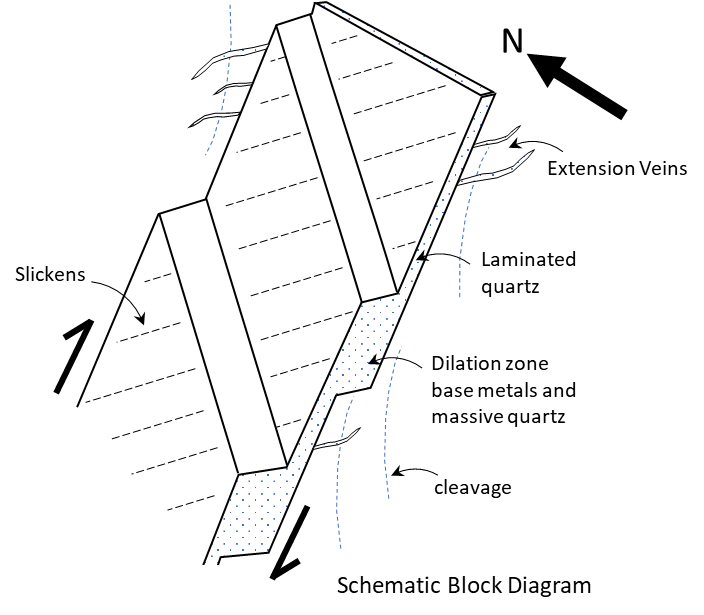
Core Prospecting’s 2026 model more than triples the contained gold defined under previous ownership, and the system is still growing
The historic Fiddlers Creek Gold Mine has passed a milestone, with Core Prospecting Pty Ltd’s latest 2026 resource model defining 38,405 tonnes at 8.15 g/t Au for 10,061 ounces of contained gold (2 g/t cut-off), the first time the deposit has been modelled above 10,000 ounces.
Since the project last changed hands from GBM, the now-delisted company that held the Bendigo goldfield, under whose ownership the resource stood at roughly 16,900 tonnes for ~3,130 ounces (Whitehouse, 2006). Core has drilled 30-plus diamond holes and re-sampled the historic underground workings to rebuild the deposit as a full 3D grade model.
That programme lifted the in-situ estimate to 30,625 tonnes at 5.4 g/t Au for 5,510 ounces at a 1 g/t cut-off in the 2023 JORC-classified Mineralisation Report,
The 2026 update extends the model well down-plunge to the south-east, tying in the newest diamond holes (FDDH008 to FDDH013). Critically, at a higher 2 g/t cut-off the deposit now carries more tonnes, a higher average grade and roughly double the contained gold of the 2023 estimate, a sign the mineralised system keeps growing, as drilling steps out into the open un-drill tested surrounds of EL007000.
Resource growth over time
| Estimate |
Year |
Cut-off |
Tonnes |
Grade (g/t Au) |
Ounces Au |
| GBM-era (Whitehouse) |
2006 |
>1 g/t |
16,927 |
5.6 |
~3,130 |
| Core (JORC 2023) |
2023 |
>1 g/t |
30,625 |
5.4 |
5,510 |
| Core (updated model 2026) |
2026 |
>2 g/t |
38,405 |
8.15 |
10,061 |
Reported at differing cut-off grades. 2006/2022 ounces calculated from reported tonnes and grade; 2023 and 2026 figures as reported by Core Prospecting. Totals may reflect rounding.
2026 model, by resource classification
| Resource classification |
Mass (t) |
Grade (g/t Au) |
Contained gold (oz) |
| Measured |
2,852 |
8.14 |
747 |
| Indicated |
15,249 |
5.81 |
2,847 |
| Inferred |
20,304 |
9.91 |
6,467 |
| Total |
38,405 |
8.15 |
10,061 |
Au Combined Estimator, 2.00 g/t cut-off, Fiddlers Vein (depleted for historic workings).
The deposit in long section
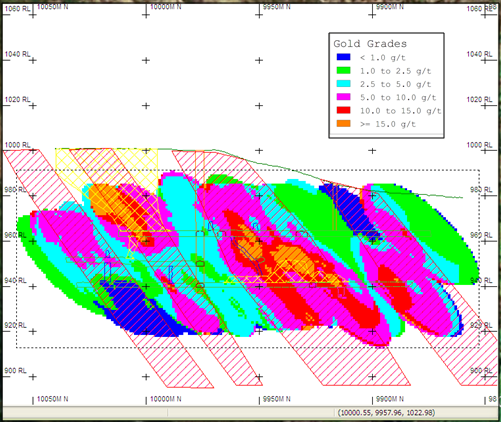
Gold-grade long section (GBM, 2006) showing the repeating high-grade shoots that plunge south through the Fiddlers Creek shear zone.
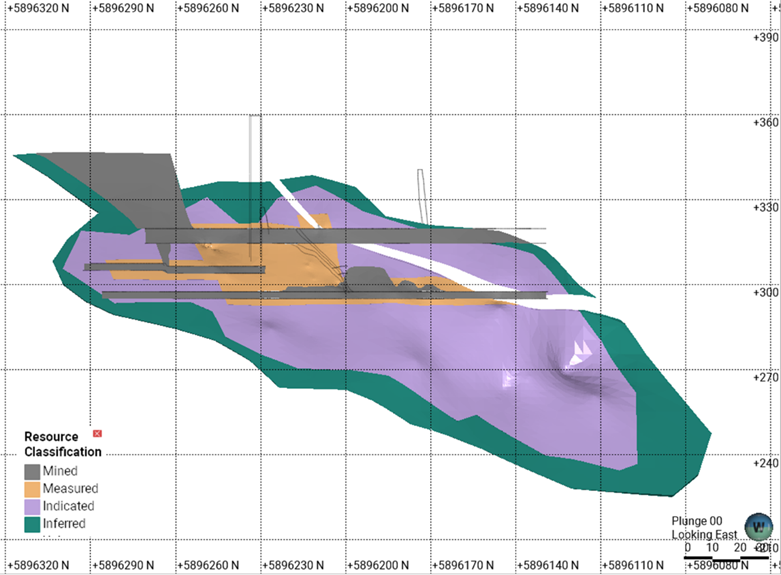
Resource-classification long section (Core, 2023): Measured, Indicated and Inferred blocks, looking east.
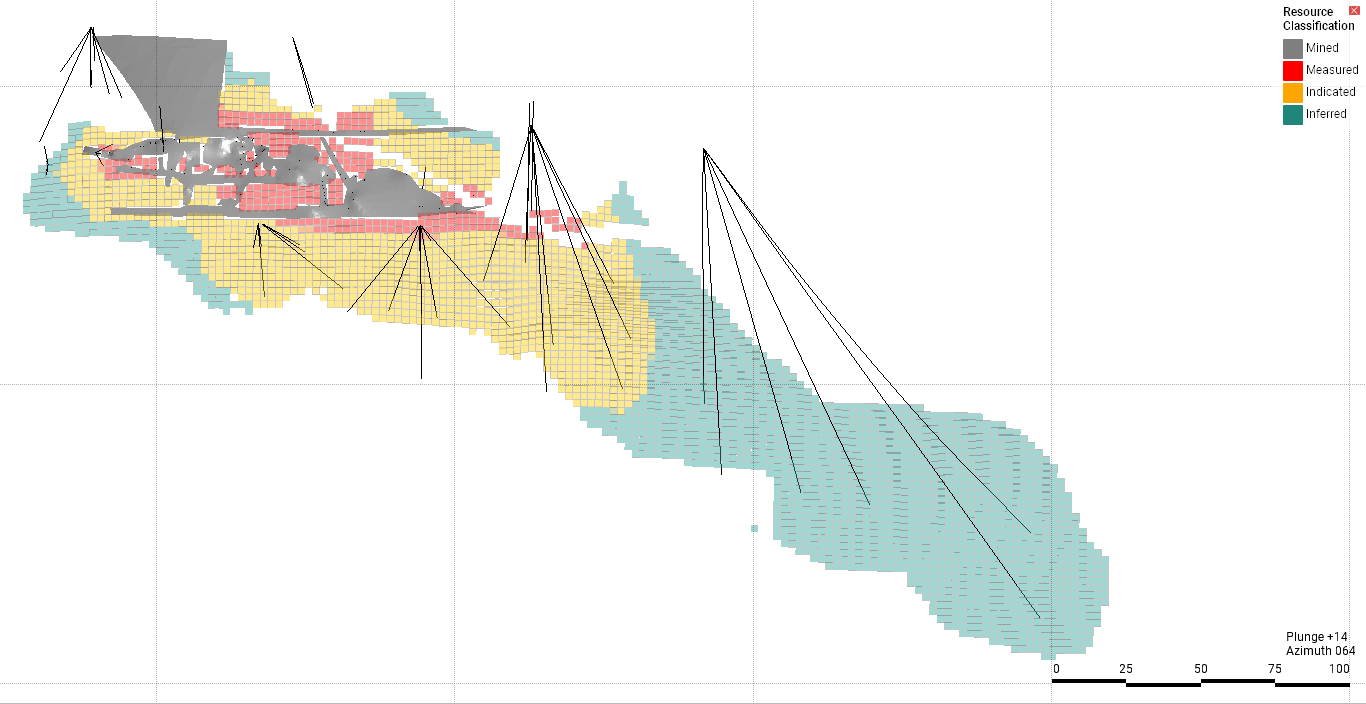
Resource-classification long section (Core, 2026): Measured, Indicated and Inferred blocks, looking east.
The resource is open, and the ground is barely tested
Crucially, the resource is not closed out. The modelled shoots remain open down-plunge to the south-east and along strike, this area has never had a single drillhole placed within and highlights the potential of continued resource growth.
The surrounding exploration tenure, also held by Core, sits on the same repeating structural grid, where parallel quartz-reef zones recur on a roughly 100 to 200 metre spacing. Several of these interpreted parallel zones, mapped on the very geometry that hosts the Fiddlers Creek shoots, have never been drill-tested, and represent untested repetitions of the same high-grade system.
Across the project Core has identified six main mineralised trends and more than 600 historical workings mapped from LIDAR and field mapping. Over 6 km of mineralised structure has been traced along several lines with continuity that carries beneath shallow cover, and that cover has never been drill-tested or below 50 vertical metres.
Still a working mine
This is a live, working operation. Core continues to develop and mine Fiddlers Creek profitably, using detailed underground mapping and face channel sampling to follow the high-grade shoots as it advances. Recent development is beginning on 4 Level, below any historic workings.
The gold sits in steeply plunging quartz shoots that repeat along strike and down-plunge; early hand-picked ore historically ran around one ounce per tonne.